
Step 1: Know what High similarity means
The level is about the two names and their classes, and nothing else. Vedette compares every new filing with your brand's words by spelling, sound and shared words. A filing is rated High when, for example, it's the same name once spelling tricks are read out, one letter apart in a longer name, or sounds the same, and it's in one of your classes. The closest of these also rate High in a related class. In an unrelated class, only the same name or a one-letter difference does.
A High alert doesn't say the other business knew about you, that the filing will be refused, or that anything has to be done. A person at Vedette reviews each High alert about a new filing before it's emailed, so it can reach you a little after the filing appears.
Step 2: Read the alert
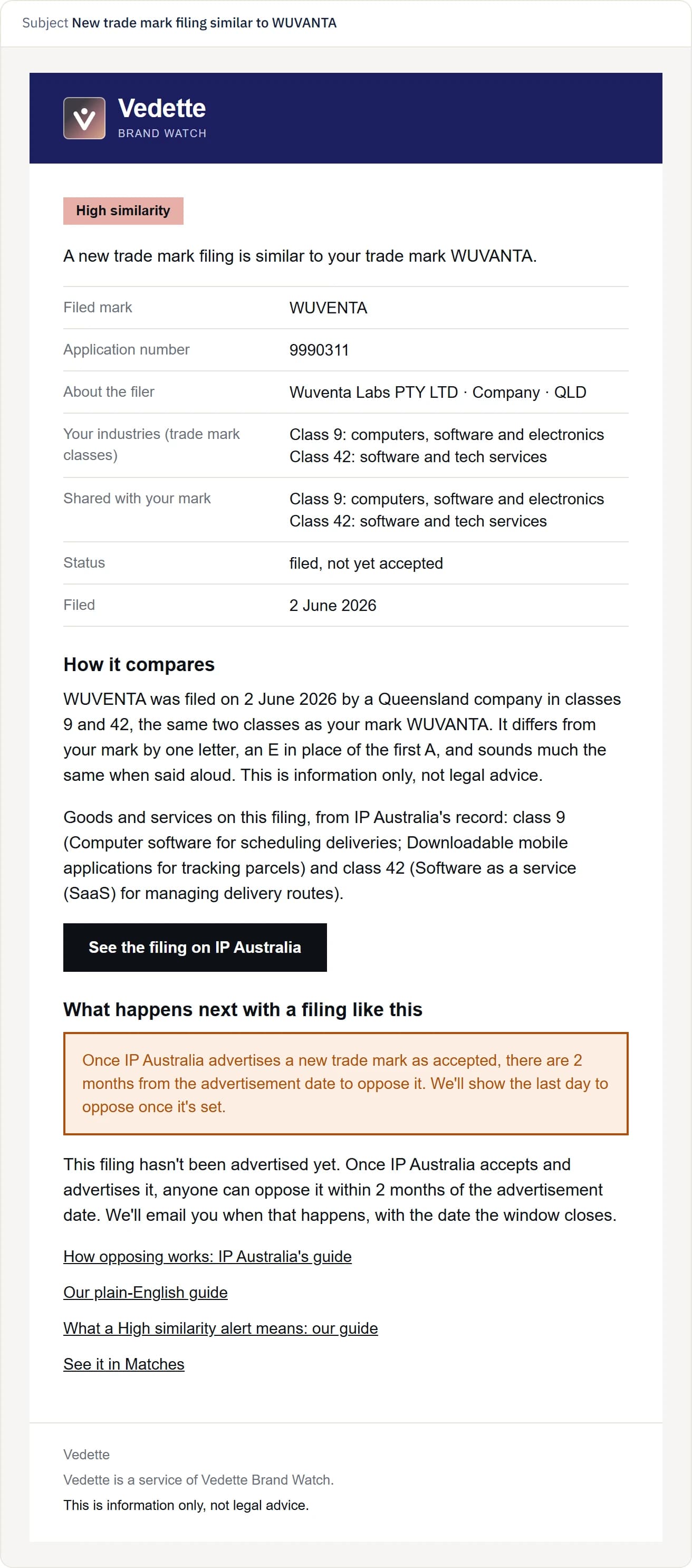
The email opens with the level and one sentence naming your brand. Under it is a table of facts from IP Australia's record:
- The filed mark and its application number.
- About the filer: a company's name and state, or for an individual the state only.
- Your industries, and which of the filing's classes are shared with yours, related to yours or in other industries.
- The status, such as "filed, not yet accepted", and the filing date.
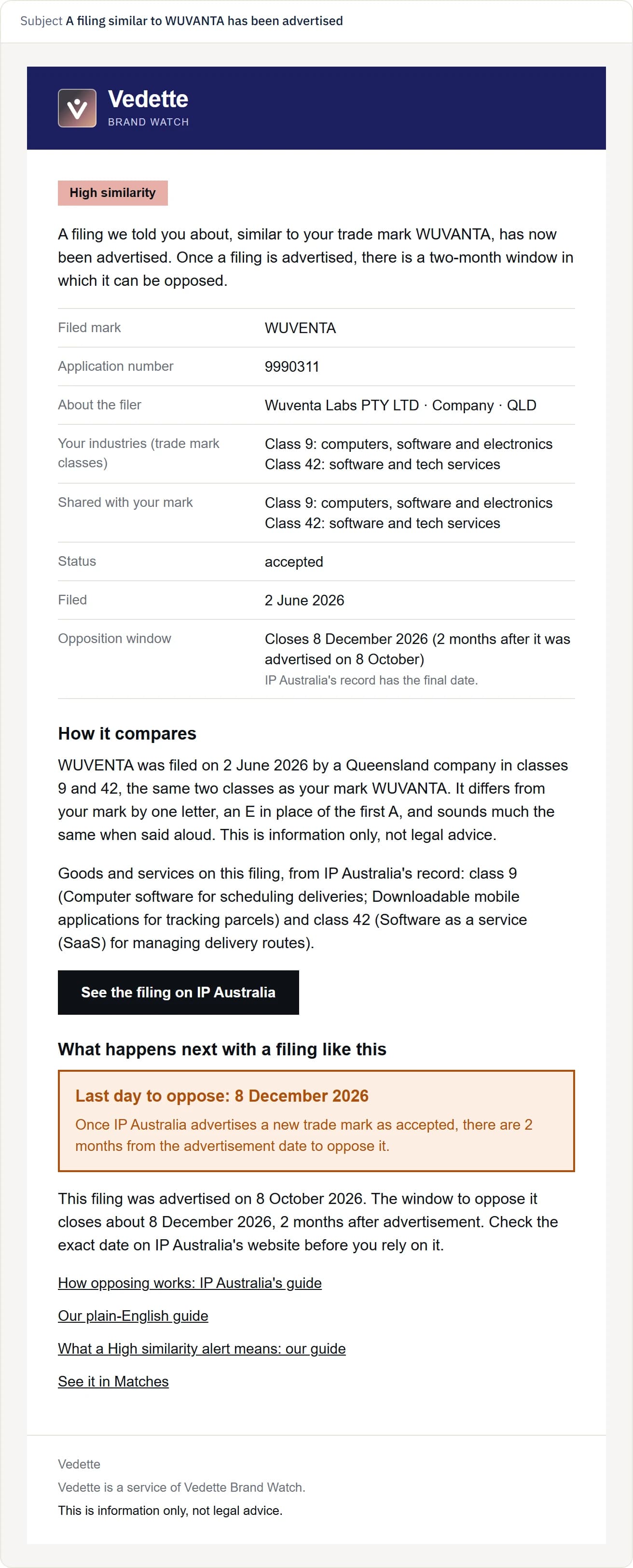
- The opposition window, once the filing has been advertised.
"How it compares" is a short summary of how the two names resemble each other. Where IP Australia's record has the wording, the line under it quotes the filing's goods and services word for word.
Step 3: Open the filing on IP Australia
The button "See the filing on IP Australia" opens the filing's own record, which is the source for everything in the alert. The record shows the mark as filed, its status, its classes, the goods and services it lists and its dates.
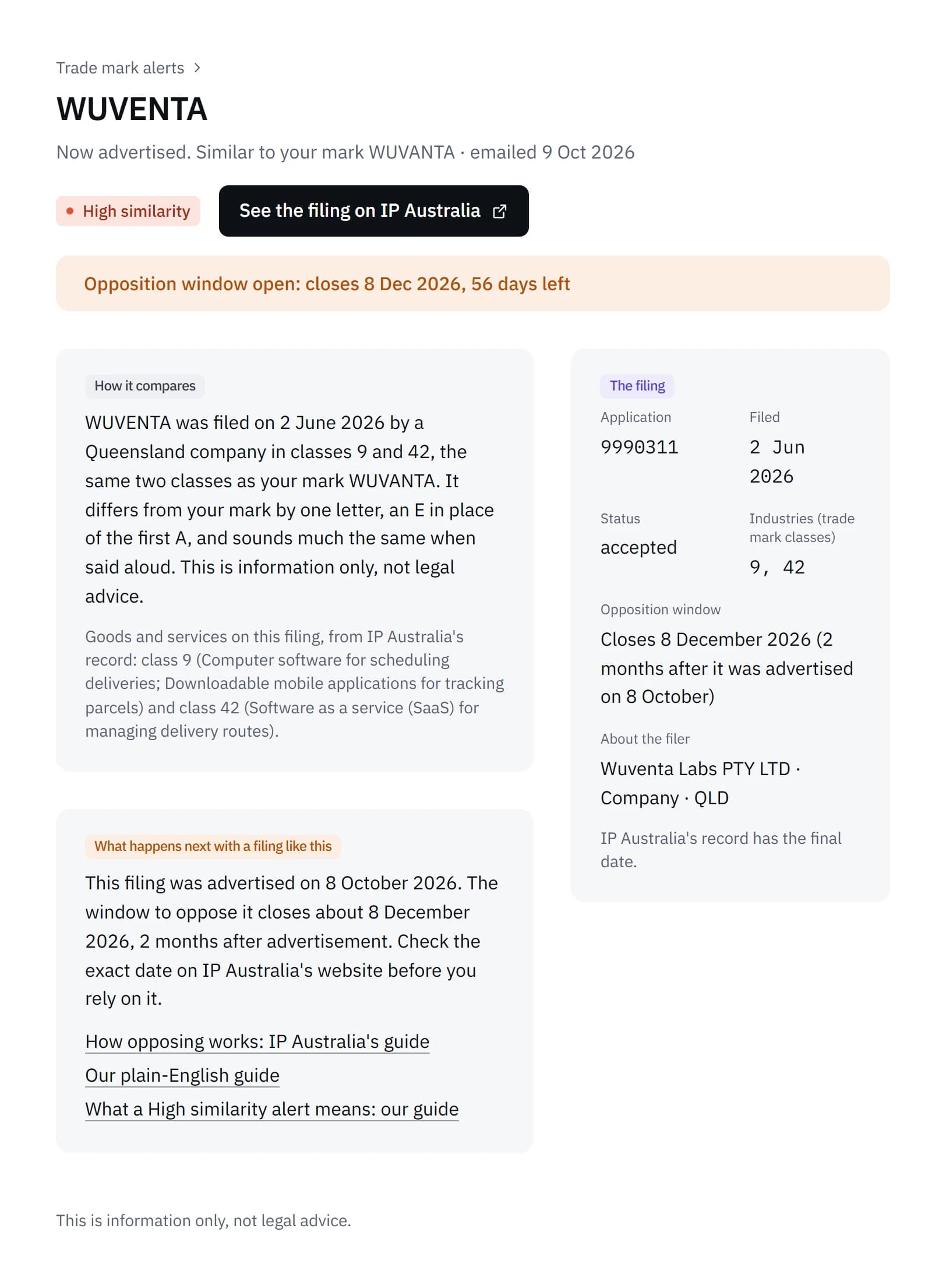
Step 4: See where it is in the process
IP Australia's timeframes page lists four steps: application, examination, acceptance and registration. It says examination usually takes 3 to 4 months from the filing date. Once an application is accepted, it's advertised for two months, and anyone can oppose it in that time. Our guide on how long a trade mark takes to register shows when the advertisement usually falls.
So a new filing has no deadline yet. Until it's advertised, the alert says "This filing hasn't been advertised yet", and there's no date to count from.
When it is advertised, Vedette emails you again once the follow-up has been reviewed: "A filing similar to WUVANTA has been advertised". That email gives the last day of the opposition period in an orange box. We work it out as 2 months from the advertisement date, moved to the next working day when it lands on a weekend or public holiday. IP Australia's record has the final date.
Step 5: Compare the goods and services
Classes are broad. Two marks can share a class and cover different things, or sit in different classes and cover related things. The goods and services wording on the record says exactly what the filing is for, and the alert quotes it for the classes closest to yours. Our guide on the same name in a different class sets out what IP Australia's examiners compare.
Step 6: Know the options and their time limits
What happens next is your decision. These are the routes IP Australia and ASIC describe, in no particular order.
Keep monitoring
Nothing has to be filed to keep watching. Vedette keeps following the filing and emails you if it's advertised.
Oppose the application through IP Australia
IP Australia's page on how to challenge someone else's IP says a notice of intention to oppose is filed through its online services within two months of the acceptance being advertised, and a statement of grounds and particulars one month after that. Its opposition fees page (checked 13 October 2026) lists $250 to file the notice. Our guide on how to oppose a trade mark covers each later step and fee.
For a business name, ask ASIC for a review
A High match can also be a business or company name on ASIC's registers. ASIC's page on asking for a review of a business name registration says a person negatively affected by a business name being registered can apply within 15 months after the day it was registered, through ASIC Connect. Our guide on someone registering a business name like yours has ASIC's steps.
Step 7: Follow it in Vedette
The match stays on your Matches page. Its tags show how it reached you, such as "Emailed" and "Now advertised", and an open window shows the days left. It's also a row in that month's monthly report.
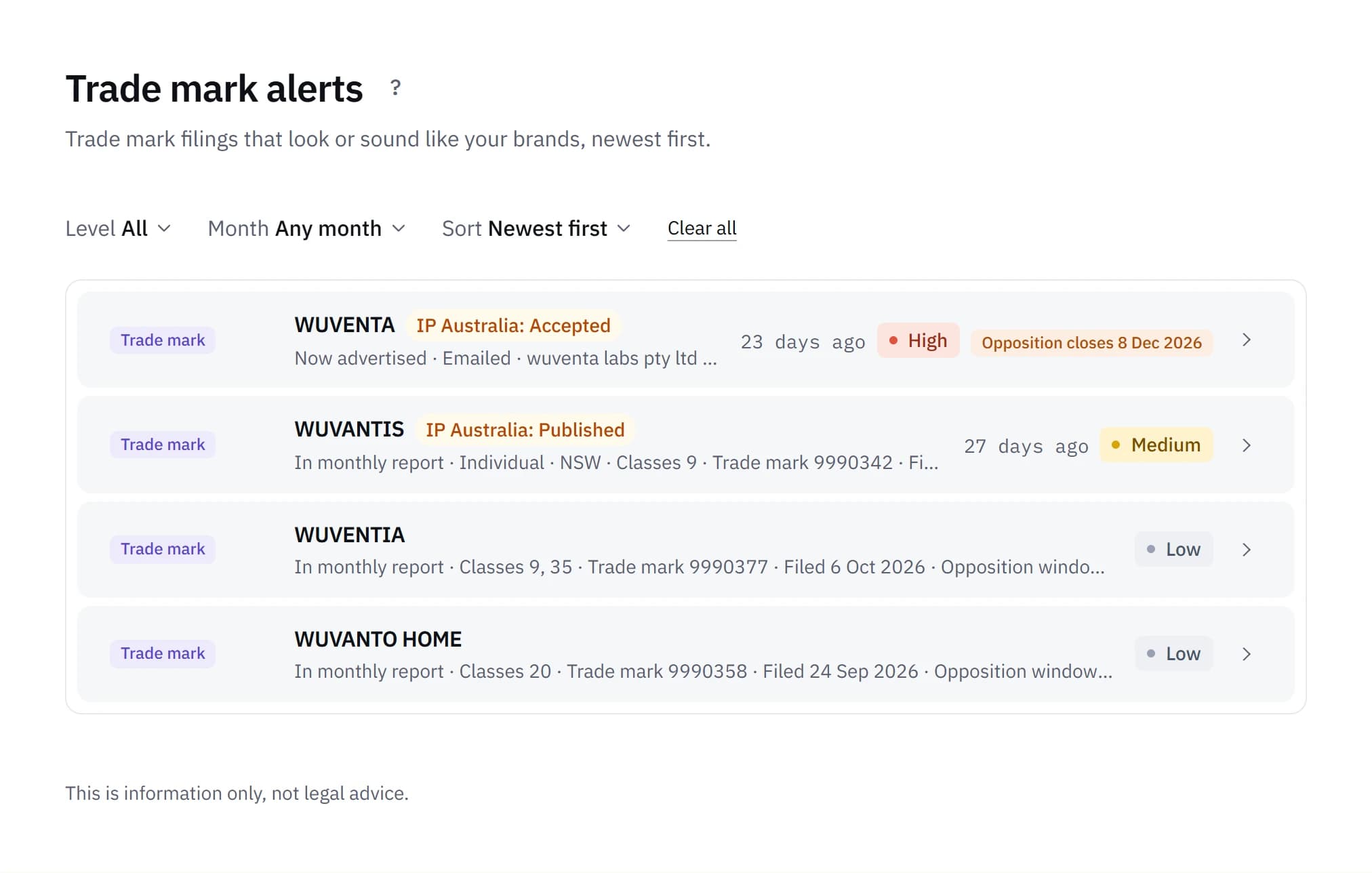
Medium matches reach you in the monthly report, or on their own if a window to oppose closes within 45 days. A person at Vedette reviews one before it's emailed on its own. Low matches are listed in your dashboard and monthly report, never emailed on their own. Our guide to monitoring your business name explains each level.
Common questions
Does a High alert mean the other business knew about my name?
No. The level describes how alike the two names are and how their classes relate. It says nothing about why the other name was chosen.
Can I still oppose after the two months?
The notice of intention to oppose is due within the two months. IP Australia's fees page lists an application for an extension of time to file it, at $150 a month. Once a mark is registered, opposition no longer applies, and IP Australia describes a different process: a request to remove a mark for non-use.
What if the alert is about a business name, not a trade mark?
Business and company names come from ASIC's registers, which we check each week. High ones are emailed once reviewed, with the date the name was registered. For a business name, the email also gives the date ASIC's 15-month review window closes by our calculation.
Will I get more emails about the same filing?
One more if it's advertised: the "now advertised" email with the last day to oppose. The filing is also listed in that month's monthly report.
Why did I get an alert when the names look different?
Vedette also compares how names sound and reads common spelling tricks, such as GR8 for GREAT or XTRA for EXTRA. Two names can be close without looking alike on the page.
Sources
- How to challenge someone else's IP (IP Australia)
- Opposition and objection fees (IP Australia)
- Trade mark timeframes and fees (IP Australia)
- Ask for a review of a decision about a business name registration (ASIC)
Fees and timeframes change, so check IP Australia's and ASIC's pages before you rely on them. What Vedette does is described as it worked on 13 October 2026.